
Alone Filming: How the Self-Documentary Format Actually Works
Published August 9, 2025
Most survival shows put a camera operator behind the survivalist. Alone does the opposite. There is no crew in camp, no producer feeding lines, no second person to hold a shot. Every frame you watch was filmed by the contestant, alone, while also trying to stay alive. That single design choice is what makes the show feel different, and it explains a lot about why the footage looks the way it does.
One person, a briefcase of cameras, and eight to ten hours of tape a day
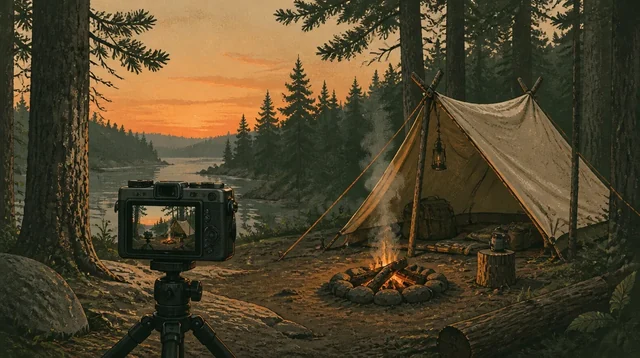
Each contestant is issued a camera kit rather than a camera crew. Reported kits center on a main camera in a hard case, a smaller handheld unit, and a pair of GoPros for point-of-view and action work, plus fixed trail cameras they can leave running around camp. The survivalist sets up every shot themselves: place the camera on a stump, walk into frame, build the shelter or gut the fish, then walk back and retrieve the gear. Those wide shots of someone hiking a ridgeline were filmed by that same person planting a tripod, walking the ridge, and hiking back for the camera.
The volume is the part people underestimate. Contestants are reported to shoot roughly eight to ten hours of footage a day, day after day, for a run that can stretch past two months. That is why the show can film for a very long time and still air a tight season. We cover the on-the-ground shooting kit in more depth in what cameras Alone contestants use, and the no-crew reality in is there a camera crew on Alone.
| Filming element | How it works on Alone |
|---|---|
| Who films | The contestant, with no crew present in camp |
| Camera kit | Main camera, handheld, two GoPros, plus trail cams |
| Daily footage | Roughly 8 to 10 hours shot per person, per day |
| Camp visits | Only a periodic medical check by an off-camera team |
| Post team | Reported 25-plus associate producers logging footage before editing |
Why the self-shot footage changes the whole show
Filming your own hunt has consequences the edit cannot hide. A contestant setting a camera for a shot is a contestant not setting a snare, and that time cost is real when calories are scarce. It also means the most dramatic moments are often the worst captured. When Jordan Jonas took a bull moose with a recurve bow in season 6, the first big-game kill in show history, nobody was standing by with a second angle. The footage exists because he thought to film it while doing it.
That trade-off shapes strategy in a quiet way. Contestants who obsess over documenting every event burn energy they need for shelter, fire, and food. The ones who last tend to treat filming as a background chore, the same way they treat firewood. The people who win rarely produce the flashiest tape.
The edit is where the season is built
The raw material is thousands of hours of solo footage from ten people, most of it uneventful by design, because real survival is mostly waiting. A large post-production team, reported at more than 25 associate producers, logs and transcribes all of it before the story team shapes episodes. The show's own editors have described the routine problem of a scene where the microphone was off, the record button was never pressed, or only a single GoPro angle survived. The tension you feel across a season is assembled after the fact from what the contestants managed to catch themselves.
None of this makes the survival fake. The rules still cap the gear at ten items, the hunger is real, and the medical checks are the only outside contact. It just means the show is two things at once: a survival contest and a solo documentary shot by people who are starving. If you want to see how long that raw footage takes to gather, how long Alone takes to film walks through the calendar. Watch a season again with the camera work in mind and the format reveals itself. Every steady shot is a person who chose, in a hard week, to go set up a tripod.
More in the Field Journal or start with the season guides.