
Every Shelter Style That Ever Won Alone
Published July 29, 2025
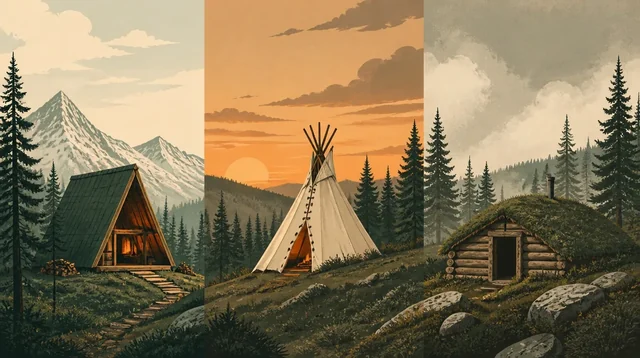
There is no single winning shelter on Alone. Look at the champions and you find A-frames, teepees, a log hut, an insulated double-wall build, and a raised sleeping platform, each matched to a different climate. What the winners share is not a blueprint. It is judgment about how much shelter is enough before the build starts eating the calories it was supposed to protect.
The styles that won
The documented winner shelters fall into a handful of recognizable types. David McIntyre won season 2 on Vancouver Island with a raised sleeping platform lifted off the wet ground and topped with a thick hemlock-bough mattress, a design built entirely around staying warm and dry. Jordan Jonas won season 6 in the Arctic with a basic A-frame, deliberately chosen over anything more elaborate so he could spend his energy on food instead. Alan Tenta built a teepee-style shelter (plus a smoker) to win season 10 on Reindeer Lake.
The most permanent build belonged to Roland Welker, whose semi-permanent log shelter in season 7 earned him the nickname "The Rock House." He had a reason the others did not: his was the only season with a fixed 100-day goal, which made a heavier, warmer structure worth the investment. Zachary Fowler took season 3 in Patagonia with a double-wall insulated hut and a scavenged wooden door he burned and shaped to fit, a "bombproof" build with strong insulation value. On Alone: Frozen, Woniya Thibeault reinforced her shelter and added a wooden door of her own on the way to reaching the 50-day cap.
| Winner | Season | Shelter style |
|---|---|---|
| David McIntyre | US 2 | Raised platform, bough mattress |
| Zachary Fowler | US 3 | Double-wall insulated hut |
| Jordan Jonas | US 6 | A-frame |
| Roland Welker | US 7 | Semi-permanent log hut |
| Alan Tenta | US 10 | Teepee style |
| Woniya Thibeault | Frozen | Reinforced hut with wooden door |
The trap of building too much
The more useful lesson is what the winners did not do. With one exception (Welker, and only because his 100-day format rewarded it), the champions did not pour weeks into a fortress. The season that shows the danger is season 9, where Igor Limansky put his effort into a heavy shelter build without securing a reliable protein source first, and was medically evacuated on day 20 with heart palpitations and exhaustion. Shelter keeps you alive at night. Food keeps you in the game for months. Contestants who inverted that priority tended to leave early, warm and starving.
What to take from it
If you are studying shelter ideas from the show, the pattern is simple. Get a dry, insulated space fast using the axe and saw that nearly every winner packed, size it to your actual climate rather than to the drone shot, and then stop and go find food. A tarp or a quick A-frame that lets you turn your attention to fishing on day three beats a beautiful cabin that leaves you too depleted to hunt on day thirty. The official gear rules shape what you have to build with, but the champions prove the build itself is rarely where seasons are won.
More in the Field Journal or start with the season guides.