
Portable Survival Kits: Pocket Tins to Trunk Boxes, Ranked by Realism
Published August 5, 2026
Most pre-made survival kits are junk. It is worth saying plainly, because the blister-pack tin on the checkout rack is designed to look reassuring, not to work when you are wet, cold, and scared. The contents were chosen to fill a card: a thumbnail compass, a book of paper matches, a whistle, a foil blanket, a few fishing hooks. Almost none of it survives contact with a real bad day. A portable survival kit is a good idea. The ones sold as a single sealed purchase usually are not.
The honesty problem
What actually matters is a short list of high-value tools you can operate with cold, clumsy hands: fire, a cutting edge, cordage, water treatment, and a way to signal. Everything else is padding.
The show this site tracks is the cleanest proof of that priority. Across the 19 season and spinoff files here, 74 of the 101 contestants whose gear is actually recorded chose a ferro rod or flint, which makes it the catalog's most-commonly-picked item. When people are betting their survival on ten objects, fire wins the vote almost every time. A pocket tin that treats a striker as an afterthought has its priorities backward.
Look closely at a cheap tin and the failures are specific. Paper matches are useless the moment they get damp, and damp is the default condition of an emergency. The foil space blanket tears on first hard use. The thumbnail compass is too small to read a real bearing. Two adhesive bandages are not first aid. None of it is malicious, it is just built to a price and a package size rather than to a cold, wet night, which is the only test that counts.
Sizes, ranked by realism
Portable kits scale, and each size is honest only if you build it around function instead of item count.
| Size | Realistic contents | Best for |
|---|---|---|
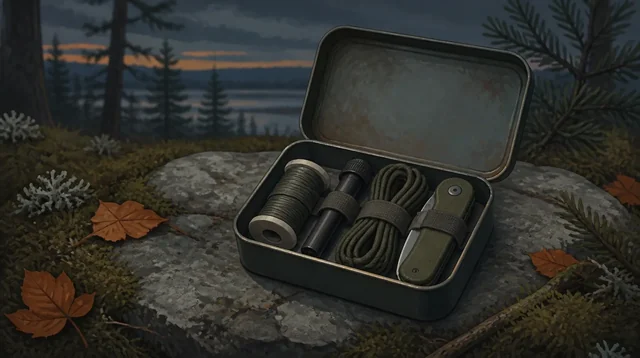
| Pocket tin | Ferro rod, tinder, small blade, whistle, cordage, water tablets | Always-on-you backup |
| Belt or pouch kit | Add a real knife, headlamp, first aid, more cordage | Day hikes, work trucks |
| Daypack kit | Add a water filter, food, a shelter layer | Longer outings, day trips gone long |
| Trunk or vehicle box | Water, blankets, tools, food, first aid, jumper cables | The genuine workhorse most people skip |
The trunk box is the one worth building first for most people, because a stranded car is a far more likely emergency than a wilderness epic, and a vehicle carries weight you would never put on your back.
Build it, mostly
The move is to buy the container and the few things you cannot easily assemble, then build the rest yourself so you know every piece and trust it. A kit you packed with your own hands is a kit you can use in the dark. Anchor it around a real ferro rod, a sturdy fixed or folding knife, quality paracord, a small fishing kit for line and hooks, and a headlamp. That handful outperforms any sealed tin on the rack.
Two categories that pre-made kits treat as afterthoughts deserve real space in yours. Signaling comes first, because being found quickly ends most emergencies, so a loud whistle and something bright or reflective earn their room. First aid comes second, because a genuine kit stocked with the bandages, tape, and personal medications you actually use does more real work than another redundant blade.
For the deeper dives, the best ferro rod guide and the fishing kit breakdown cover the two items most worth getting right, the 10-item rules show the minimalism taken to its logical end, and the 72-hour bug-out bag is the next size up when a pocket kit is not enough.
More in the Field Journal or start with the season guides.