
Power Outage Emergency Kit: What to Actually Have Ready
Published July 28, 2026
A power outage is the disaster most households actually experience, and the kit for it is refreshingly boring. You are not preparing for the end of the world. You are making sure that when the grid drops for a day or three, you have light, a way to stay warm and cook, safe water, some food, a radio, and a charged phone. That is the entire job.
The checklist
Assemble this once, keep it in one place, and check it twice a year. FEMA's Ready.gov guidance is the useful backbone for the water and food quantities.
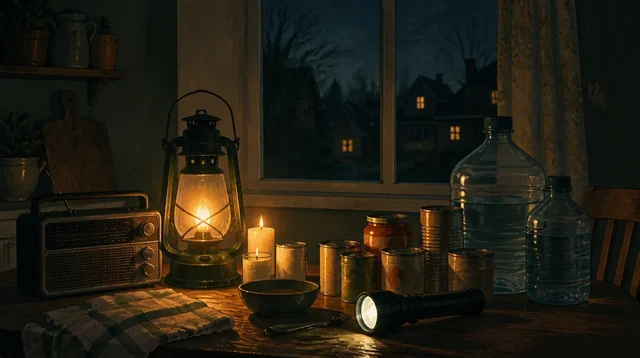
| Category | Have ready | Why |
|---|---|---|
| Light | Headlamp plus a flashlight, spare batteries | Frees your hands; skip candles, which are a fire risk |
| Power | Charged power bank, USB cables | Keeps a phone alive for calls and alerts |
| Comms | Battery or hand-crank NOAA weather radio | News and alerts when the phone network strains |
| Water | Stored water, roughly one gallon per person per day for several days | Pumps and treatment plants can fail with the grid |
| Food | Non-perishable food, manual can opener | No cooking required; the opener is the forgotten piece |
| Warmth | Blankets, warm layers, sleeping bags | Heat may go with the power |
| Cooking | Camp stove or grill, used outdoors only | Carbon monoxide indoors is the real killer |
The one rule to burn into memory: never run a generator, grill, or camp stove inside the house or garage. Carbon monoxide from indoor combustion is the most common way a blackout turns fatal, and it is entirely preventable.
Two more habits pay off once the lights are actually out. Keep the refrigerator and freezer doors shut: a full freezer holds its temperature for roughly 48 hours unopened, a half-full one for about 24, and food kept at or below 40 degrees is generally still safe. Ready.gov's rule for anything questionable is the simple one, when in doubt, throw it out. And keep at least half a tank of fuel in the car, both so you can leave if you need to and because a running vehicle is a workable phone charger.
The Alone lesson, applied
People on Alone live for weeks and sometimes months with no grid power at all, and what carries them is never gadgets. It is a reliable way to make light and heat, water made safe by boiling, and disciplined use of a very short list of tools. On the show that means fire from a ferro rod instead of a switch, water boiled in a pot rather than filtered, and a 10-item mindset where nothing dead-weight comes along.
The blackout version of that lesson is simple: the humble basics beat a drawer of dead devices. A dependable flashlight with fresh batteries, stored water, and a way to make heat will do more for you than any smart-home gizmo that needs the power it no longer has.
The mistakes that leave people stuck
The failures repeat. People lean on the phone's flashlight and drain the battery they need for alerts. They forget a manual can opener and stare at cans they cannot open. They let power banks and devices sit half-charged, then lose the window to top them up. They forget a week of any prescription medications. And they bring combustion indoors for warmth. None of these are exotic. They are the same short list every time, which is exactly why a staged kit beats improvising in the dark.
For the disaster-specific versions of this, the hurricane checklist adds the evacuate-or-shelter layer, the tornado kit covers shelter-in-place, the 72-hour bug-out bag is the grab-and-go version, and non-perishable food goes deep on what to actually stock.
More in the Field Journal or start with the season guides.