
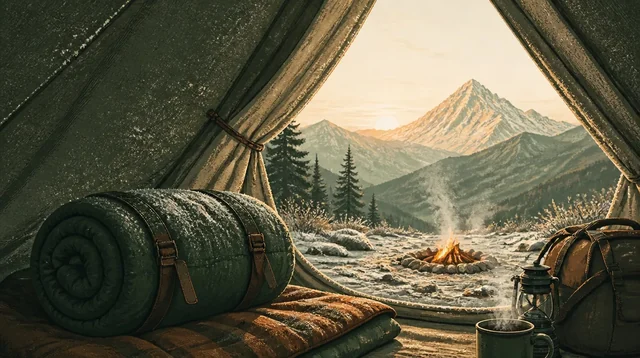
The Sleeping Bag Decision That Shapes Every Alone Run
Published September 2, 2025
Every other item on a ten-item Alone list gets used occasionally. The sleeping bag gets used every single night, in whatever cold actually shows up, for as long as the contestant lasts. That makes it one of the few choices made months before filming that a contestant can never really correct once they're dropped off. The ratings recorded across the show's seasons swing from 0°F to a reported -100°F, and the gap between those numbers says more about the show's range of filming locations than about any one contestant's toughness.
What winners actually packed
William Larkham Jr. won season 11 in the Mackenzie River Delta, north of the Arctic Circle, with a Pajak Radical 16H down bag rated to -100°F, the most extreme rating in the recorded data. Sam Larson won season 5 in Mongolia with a Wiggy's Antarctic bag rated to -60°F. Roland Welker won season 7 at Great Slave Lake with a synthetic rectangular bag rated only to -30°F, twenty degrees warmer than Larson's and still good enough for a 100-day run. David McIntyre won season 2 on Vancouver Island, a milder coastal location, with a 0°F bag, the warmest rating on any winner's list.
| Season | Winner | Location | Bag rating | Days |
|---|---|---|---|---|
| US 2 | David McIntyre | Vancouver Island, BC | 0°F | 66 |
| US 9 | Juan Pablo Quiñonez | Labrador | -30°F (synthetic/down hybrid) | 78 |
| US 7 | Roland Welker | Great Slave Lake, NWT | -30°F | 100 |
| US 6 | Jordan Jonas | Great Slave Lake, NWT | -40°F (down) | 77 |
| US 8 | Clay Hayes | Chilko Lake, BC | -40°F (down) | 74 |
| US 5 | Sam Larson | Mongolia | -60°F | 60 |
| US 11 | William Larkham Jr. | Mackenzie River Delta, NWT | -100°F | 84 |
The two winners who skipped it
Not every winner carried one at all. Jim Baird and Ted Baird won season 4's "Lost & Found" as a team without a sleeping bag anywhere on their shared ten-item list, using a 12-by-12-foot tarp and their rations allowance in its place. Nathan Olsen won season 12 in South Africa's Great Karoo, a semi-arid desert, with a blanket instead of a sleeping bag, alongside soap and salt rather than an axe or a saw. His run also lasted only 34 days, the shortest winning stay in the tracked data, in an environment where the ground never froze the way it does at the show's Arctic locations. Whether that gear list reflects the desert setting specifically or a strategic bet by these particular contestants isn't spelled out in the source data, but the location lines up with the choice.
Season 3, filmed in Patagonia, shows how much variance can exist inside a single season. Recorded ratings there ran from -14°F (Megan Hanacek, 78 days) up to -40°F (Zach Gault, 8 days, and Callie North, 72 days), with winner Zachary Fowler in between at -20°F over 87 days. A colder-rated bag didn't reliably predict a longer stay in that cast; other factors, food, shelter, mental fortitude, clearly did more work than the bag's temperature number alone.
Why it's the hardest item to get wrong
Official documentation on sleeping bag rules only describes the requirement as "multi-seasonal," with no specific temperature floor or ceiling documented in any source reviewed for this catalog. That leaves the actual rating entirely up to the contestant, which turns it into a bet made in advance about how cold the specific filming location and specific winter will get, a bet an axe or a knife choice doesn't require in the same way; those tools can be worked around with improvisation, but a bag that's ten degrees too warm on an unusually cold night has no substitute at 2 a.m.
The sleeping bag gear page has the recorded models and ratings in full, and the bivy bag page covers the item a handful of season 1 contestants packed as a backup layer over their bag. For how the show's filming locations vary season to season, see the locations breakdown, and for the complete allowed-items list, the official rules page.
More in the Field Journal or start with the season guides.