
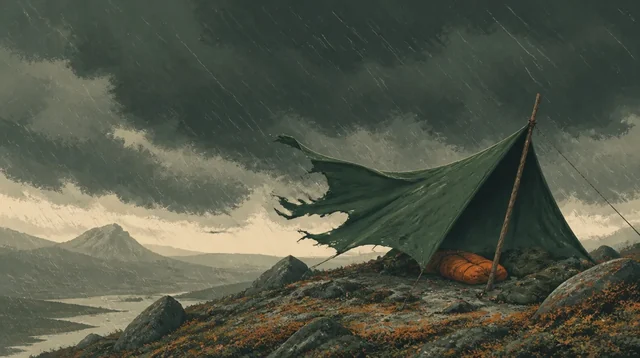
The Worst Weather Disasters in Alone History
Published August 2, 2025
Weather on Alone rarely kills a run outright. What it does is break the thing keeping you going, your shelter, your feet, or your resolve, at the exact moment you have nothing left in reserve. Pulling the storm and cold-related notes from every season's contestant data, a few events stand out as the ones that genuinely decided outcomes.
The storm that ended season 1
The most famous weather moment in the show's history closed out season 1. Sam Larson had set himself a personal goal of 50 days on northern Vancouver Island and reached it, then a major storm hit the island and, by his own account, he lost the mind game and tapped on day 55. That single storm handed Alan Kay the win. Earlier that same season, Dustin Feher had already tapped on day 8 purely over fear of an incoming storm, before it even arrived. Weather doesn't have to touch you to end your run.
Frostbite in the far north
The colder seasons trade storms for a slower, more permanent danger. On season 7, filmed through an Arctic winter on Great Slave Lake, runner-up Callie Russell reached day 89 before frostbite in her toes forced a medical evacuation, leaving Roland Welker to finish the season's fixed 100-day goal as the only person still standing. On season 8, Rose Anna Moore's foot turned purple from frostbite and she blacked out before her day-37 evacuation. And on season 10 at Reindeer Lake, the coldest and most northern setting the show had used to that point, third-place Mikey Helton was pulled on day 55 for severe hypothermia risk.
| Contestant | Season | Day | Weather event |
|---|---|---|---|
| Sam Larson | US 1 | 55 | Tapped after a major island storm |
| Callie Russell | US 7 | 89 | Frostbite of the toes, evacuated |
| Rose Anna Moore | US 8 | 37 | Frostbite, blacked out before evac |
| Mikey Helton | US 10 | 55 | Severe hypothermia risk |
| Nathan Donnelly | US 6 | 72 | Shelter burned down in sub-zero cold |
| Greg Ovens | US 3 | 51 | Hypothermia after wading a lake |
Cold, water, and fire in the same night
Some of the worst outcomes come from cold and a second failure stacking together. On season 6, third-place finisher Nathan Donnelly lost his shelter when it caught fire and burned down overnight in sub-zero temperatures, forcing him to wait outdoors until rescue arrived at daybreak. On season 3 in Patagonia, Greg Ovens developed hypothermia after prolonged wading in the lake and tapped on day 51. Even the desert version bit back: on the Africa-set season, contestants who had planned for heat were undone by wet-weather struggles instead.
The pattern across all of it is that weather is a compounding force, not a standalone one. A storm on its own is survivable, and a cold night on its own is survivable, but stack a soaked fire kit onto a sub-zero night and the margin disappears. The runs that made it through these conditions, especially Welker's 100-day season 7, belonged to people who had already solved shelter and warmth before the weather tested them. For the medical side of these same events, our full evacuation breakdown tracks how many of these cold-weather calls ended with the medical team making the decision.
More in the Field Journal or start with the season guides.