How Alone Contestants Start Fires (and What Happens When They Cannot)
Published June 25, 2026 · Updated September 12, 2026
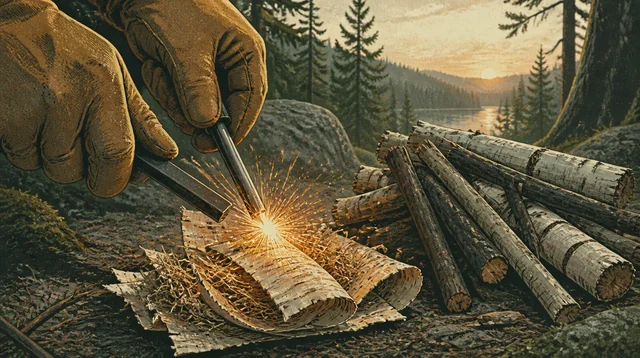
Every contestant on Alone gets exactly one dedicated fire-starting tool in their ten items, almost always a ferro rod, and that single choice ends up mattering more than almost anything else they pack. No matches, no lighters, no backup rod hidden in a pocket. If you lose it or it fails, you're improvising with bow drills and hand drills in conditions the show deliberately does not make easy.
Here's what the data across seasons actually shows about fire failures, and it's more common than you'd think.
When losing the fire starter ends a season
Joe Robinet, who finished 8th in season 1, tapped out specifically because he lost his ferro rod with no reliable backup way to start fire. He went on to become a major bushcraft YouTuber, so losing that rod clearly didn't reflect a lack of skill, it reflected how unforgiving the show's one-tool rule really is.
Shawn Helton in season 7 left at day 10 after losing his fire-starting ferro rod. And in season 13, Dave Booth had about as rough a run as the show has documented: he lost his primary fire on day 1, then accidentally dropped and burned his own ferro rod in the fire on day 4. He'd just harvested a 40-lb beaver that same day, so food wasn't his problem, fire was, and with no reliable way to start one in wet conditions he tapped out.
| Contestant | Season | Days lasted | What happened |
|---|---|---|---|
| Joe Robinet | US 1 | placement 8th | Lost ferro rod, no backup |
| Shawn Helton | US 7 | 10 | Lost ferro rod |
| Dave Booth | US 13 | 4 | Lost fire day 1, burned rod day 4 |
| Beck Henog | AUS 1 | 2 | Could not start fire, wet materials |
| Baha Mahmutov | US 12 | 19 | Struggled with fire maintenance and food scarcity |
Wet conditions are the real enemy
Beck Henog's exit in Alone Australia season 1 at day 2 came down to wet materials making fire impossible, combined with missing family. That's the pattern worth noticing: it's rarely that a contestant forgets how to use a ferro rod. It's that damp tinder, rain, and humidity turn a skill that works fine in a backyard demo into something that eats hours of a short winter day with no guaranteed payoff.
Not every fire problem ends a season outright. Baha Mahmutov in season 12 struggled with fire maintenance for weeks before it combined with food scarcity to force a day 19 exit. And on the more extreme end, Nathan Donnelly in season 6 made it to day 72 before his shelter caught fire and burned down overnight in sub-zero temperatures, forcing him to wait outdoors until rescue arrived. That's not a fire-starting failure so much as a reminder that fire itself is a hazard once you're relying on it inside a wood and tarp structure every single night for months.
What the survivors tend to do differently
Winners rarely talk much about fire on camera because it isn't dramatic when it works. The common thread among long runs is redundancy of effort rather than redundancy of tools, since the show only allows one fire starter anyway. Contestants who last build fire-safe shelters, keep dry tinder stockpiled ahead of bad weather, and treat their ferro rod like the single most protected item in their kit, often literally tying it to themselves.
If you're curious how fire-starting fits into the bigger picture of what's allowed and what isn't, the official rules page covers the full ten-item system, and the gear database breaks down every approved tool category including fire.
Season 13: winning with friction fire
Žiga Ogorelec won the completed World Championship after 90 days without a packed ferro rod. His friction-fire work offers a different Season 13 result from Dave Booth’s early departure. The distinction is practiced ability and a functioning camp system; it does not make losing a fire starter harmless. Read the full episode guide for the season’s sequence.
More in the Field Journal or start with the season guides.