What Alone Contestants Actually Eat, Season by Season
Published August 28, 2025
Watch enough Alone and you notice the food changes completely with the map. A coastal season looks nothing like an Arctic one, and the winners are usually the people who read their environment fastest and built a diet around whatever it actually offered. Here is what the champions ate, biome by biome, drawn from each season's own winner narrative.
Coastal seasons run on the tideline
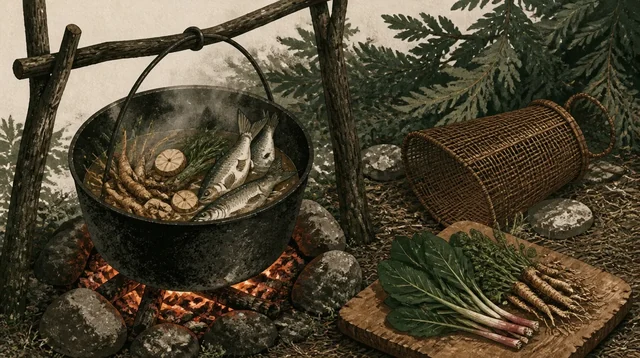
The three seasons filmed on Vancouver Island were shellfish games. Alan Kay won season 1 subsisting mainly on limpets and seaweed, supplemented with mussels, crab, fish, and slugs pulled from the tideline, and that steady low-effort food is credited as the reason he outlasted the big-game hunters. David McIntyre turned a brutal early food shortage around in season 2 with a gill net, a seafood box trap, and a floating fishing line. Even the Baird brothers, deep into season 4's winter, fell back on limpets scavenged from the shoreline when everything else ran thin.
Inland lakes and rivers run on fish
Move away from the ocean and the fishing kit becomes the engine. In Patagonia, Zachary Fowler had no coastal food at all and survived mainly on dozens of trout, plus two birds, grubs, and foraged plants. William Larkham Jr., a commercial fisherman, leaned on a homemade gill net in the fish-rich Mackenzie River Delta to win season 11. Even in South Africa's Great Karoo desert, the driest location the show has ever used, Nathan Olsen won season 12 by catching so many fish he described the acacia trees near his camp as loaded with drying strips.
| Season | Location | Main food source |
|---|---|---|
| US 1 | Vancouver Island | Limpets, seaweed, shellfish |
| US 3 | Patagonia | Trout, grubs, foraged plants |
| US 6 | Great Slave Lake | Bull moose, then fish and small game |
| US 9 | Labrador | Fish (fly line and monofilament) |
| US 11 | Mackenzie Delta | Gill-netted fish |
| US 12 | Great Karoo | Fish |
| AUS 3 | Tasmania | Eels, fish, plants, worms |
Arctic seasons are where big game appears
The far north is the one place a large kill becomes plausible, and it changes everything when it lands. Jordan Jonas won season 6 after taking a bull moose with his recurve bow around day 20, several hundred pounds of meat that he stretched with fishing and trapping. Roland Welker reportedly killed a bull musk ox on day 29 of season 7, finishing it with his belt knife after running out of arrows, then lived on that dried meat for the rest of his 100-day run. Clay Hayes harvested a deer in season 8 and ate its heart on the spot. But note the pattern: even these hunters ate fish and small game most days. The big kill was a bonus on top of a fishing habit, not a replacement for one.
The outlier is eating nothing much at all
A few winners barely fit any category. Krzysztof Wojtkowski won Alone Australia season 2 without eating meat for the entire season, leaning on foraging and sheer mental resilience in Fiordland. Sam Larson won season 5 in Mongolia carrying flour and trail mix instead of a fishing kit or a bow, and simply outlasted a field that quit over homesickness. Those runs are the exception that proves the rule: reliable food usually wins, but occasionally the last person standing is just the one who refused to leave.
More in the Field Journal or start with the season guides.