
What Do Alone Contestants Sleep In? Shelters and Bags
Published July 7, 2026
What Alone contestants sleep in comes down to two separate decisions that have to work together: the shelter they build on site, and the one sleeping bag they choose to bring. Get either wrong and the nights end the run before hunger ever does. Here is how the two halves fit.
The shelter half
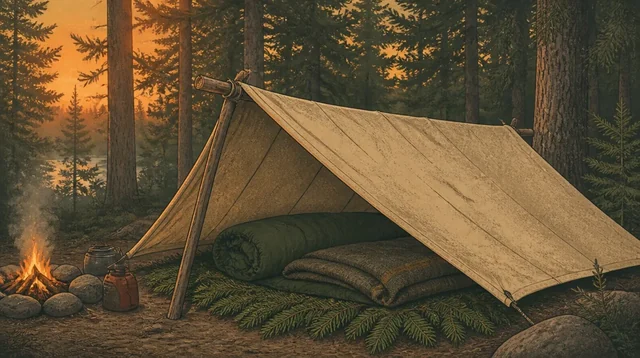
The shelter is built, not carried. Contestants arrive with a tarp and cordage from their 10-item list, then construct everything else from what the site provides. Over 13 US seasons a few shelter styles have actually carried people to a win, and they cluster around a simple principle: small, insulated, and heatable beats large and impressive. I ranked the ones that have won in every shelter style that ever won Alone.
The recurring winners are tight, low-volume builds, a lean-to backed by a fire and reflector, a partially dug-in earth shelter, or a small log structure a person can actually warm with body heat and a fire. What almost nobody does is bring a tent. It seems like the obvious move and it is the wrong one, for reasons I lay out in why nobody brings a tent on Alone: a tent traps no usable heat, cannot be fed by a fire, and burns a precious item slot on something a built shelter does better.
The sleeping bag half
The bag is the other half, and it is one of the most consequential single-item picks on the list. The rules describe the allowed sleeping bag only qualitatively, as "multi-seasonal," with no documented temperature-rating cap in the sources reviewed, so contestants effectively bring the warmest serious bag they can justify. I break down the trade-offs in the sleeping bag decision that shapes every Alone run, and the category itself sits in the gear database.
The tension is that the bag is one of your 10 slots. A heavy cold-rated bag is close to non-negotiable in an Arctic or late-autumn season, but it is one fewer slot for a gill net, a bow, or extra cordage. That is why bag choice tracks so tightly with location.
How the two decisions combine
Neither piece works alone. A great bag inside a leaky, un-heatable shelter still loses heat to the ground and the wind; a superb shelter with a thin summer bag still leaves you shivering through the coldest hours. The contestants who sleep well, and therefore last, are the ones who treat these as one system: shelter that blocks wind and holds fire-heat, bag that covers the gap the shelter cannot.
| Layer | What it is | Slot cost |
|---|---|---|
| Shelter | Built on site from natural materials plus the tarp | Tarp and cordage from the 10 items |
| Sleeping bag | Carried, "multi-seasonal," warmth-first | One of the 10 items |
| Ground insulation | Boughs, grass, a raised bed, all built | None, made on site |
That last row is the piece beginners forget. Most heat is lost downward into cold ground, so the raised or insulated sleeping platform, free to build, often matters as much as the bag that cost a slot.
Put together, the answer to "what do they sleep in" is: a small, fire-warmed shelter they built, a warm bag they chose carefully, and a bed of natural insulation between them and the ground. For the item-selection logic behind all of it, the rules page has the constraints, and the gear database has the categories.
More in the Field Journal or start with the season guides.